
What to expect when you hire a commercial electrical contractor
By Amara Okafor · Updated 2026-06-27
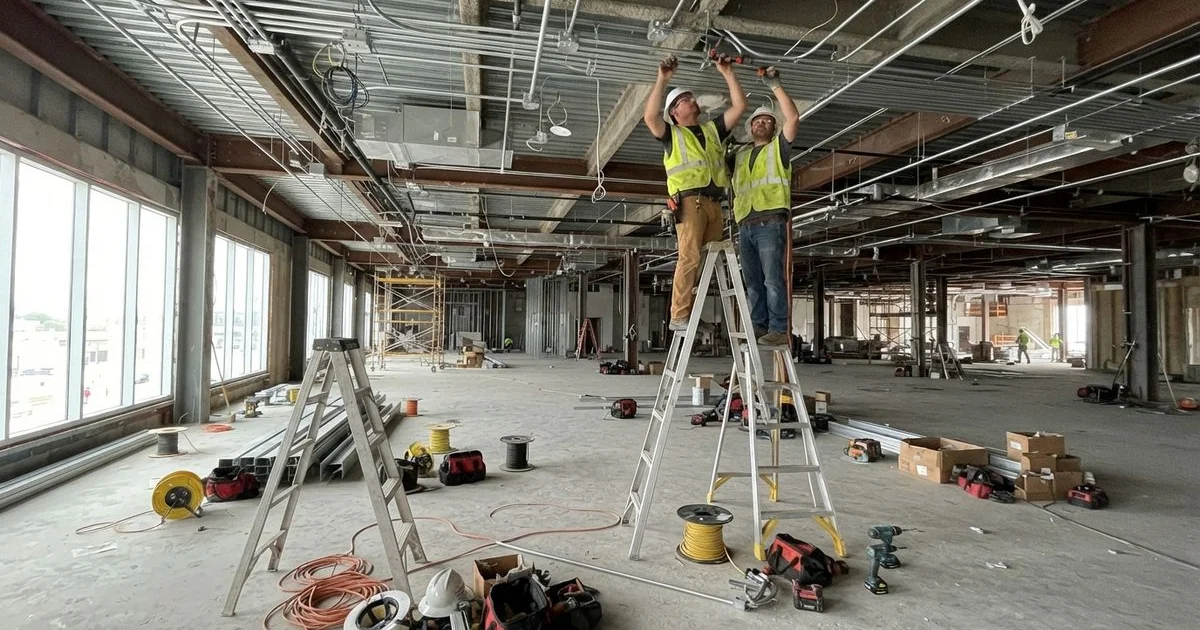
Commercial electrical work covers a wider range than most business owners expect: panel upgrades, lighting retrofits, tenant build-outs, dedicated circuits for kitchen or shop equipment, exterior and parking lot lighting, fire alarm tie-ins, and emergency generator hookups. It’s a different discipline than residential work, and hiring the wrong fit can cost you time on a project with a hard deadline like a lease start date.
What makes commercial work different
Three things separate commercial jobs from a typical residential call. First, load: offices, restaurants, warehouses, and retail spaces often need three-phase power and higher-capacity circuits that most homes never touch. Second, permitting: commercial work runs through a separate permitting track at the city or county level, often tied to a certificate of occupancy or a general contractor’s overall build-out permit. Third, scheduling: contractors have to work around business hours to limit downtime, or plan for after-hours and weekend work if the space can’t go dark during the day.
What a good contractor handles for you
- A real load calculation, not a guess, especially if you’re taking over a space from a previous tenant with different equipment
- Permit coordination with the general contractor or landlord, so electrical work doesn’t become the bottleneck on your opening date
- Code compliance specific to commercial spaces: exit lighting, ADA-compliant switch heights, dedicated circuits for kitchen or retail equipment
- A written scope and timeline, not just a price, particularly for anything involving a planned shutdown or work near a deadline
Questions worth asking before you sign
| Question | Why it matters |
|---|---|
| Are you licensed for commercial work in South Carolina? | Commercial licensing and insurance requirements differ from residential |
| Who pulls the permit, and how long does it typically take? | Permit delays are the most common cause of missed opening dates |
| Can you show recent work similar to mine? | A restaurant kitchen build-out is a different job than an office lighting retrofit |
| How do you handle work during business hours? | Downtime matters more for an active business than an empty home |
| What’s included in the written scope? | Protects you if the job’s actual conditions differ from the initial walkthrough |

What a typical build-out project looks like
For a new tenant fitting out a retail space, restaurant, or office suite, the electrical work usually runs alongside the general contractor’s overall schedule rather than as a standalone job. That means the electrician needs to coordinate timing with drywall, flooring, and other trades, not just show up and wire independently. Expect an initial walkthrough and load calculation, a written scope covering new circuits and lighting layout, permit filing that’s often bundled with the broader build-out permit, the actual installation work, and a final inspection before the space can open. Delays in any one step, especially permitting, tend to ripple through the whole project timeline.
Signs you’re dealing with a solid commercial contractor
Reviewers of Spartanburg’s commercial electricians consistently point to a few things that separate a smooth project from a frustrating one: contractors who can read plans and act on them without hand-holding, who show up when scheduled for time-sensitive commercial work, and who catch capacity issues before they become expensive change orders mid-project. A contractor who treats permitting as routine, rather than an afterthought, tends to move faster through the county’s process than one who doesn’t.
Get a written scope and timeline before work starts, especially for anything involving a shutdown or a hard deadline like a lease start date. Verbal estimates on commercial jobs have more room to drift once the electrician actually opens up walls or a ceiling and finds different conditions than expected.
It’s also worth asking how a contractor handles change orders, since commercial projects are more prone to mid-project surprises than a typical residential job. A contractor who documents changes in writing and gets sign-off before proceeding protects both sides if the final invoice looks different from the original quote.
To compare local commercial electrical contractors, see the commercial electrical category, where providers are scored using the criteria explained on the methodology page. You can also start from the home page if you’re comparing commercial work against other electrical categories in Spartanburg.
Questions people ask
- How is commercial electrical work different from residential?
- Commercial jobs more often involve three-phase power, higher loads, permitting through the city or county's commercial track, and coordination around business hours to limit downtime. Fire alarm tie-ins and dedicated circuits for kitchen or shop equipment are also more common on the commercial side.
- Who pulls the permit for a commercial build-out?
- Usually the electrician pulls the electrical permit as part of the job, but it's coordinated with the general contractor's overall permit for the space if you're doing a full build-out rather than a standalone repair.
- Does every tenant space need a panel upgrade?
- Not always. It depends on what the previous tenant used the space for and what your new equipment or lighting load requires. A proper load calculation from the electrician confirms whether existing capacity is enough.
- How far in advance should I schedule commercial electrical work?
- As early as possible, ideally as soon as a lease is signed, since permitting and inspection scheduling can take longer than the actual wiring work, especially if you're working toward a lease start date or opening deadline.